
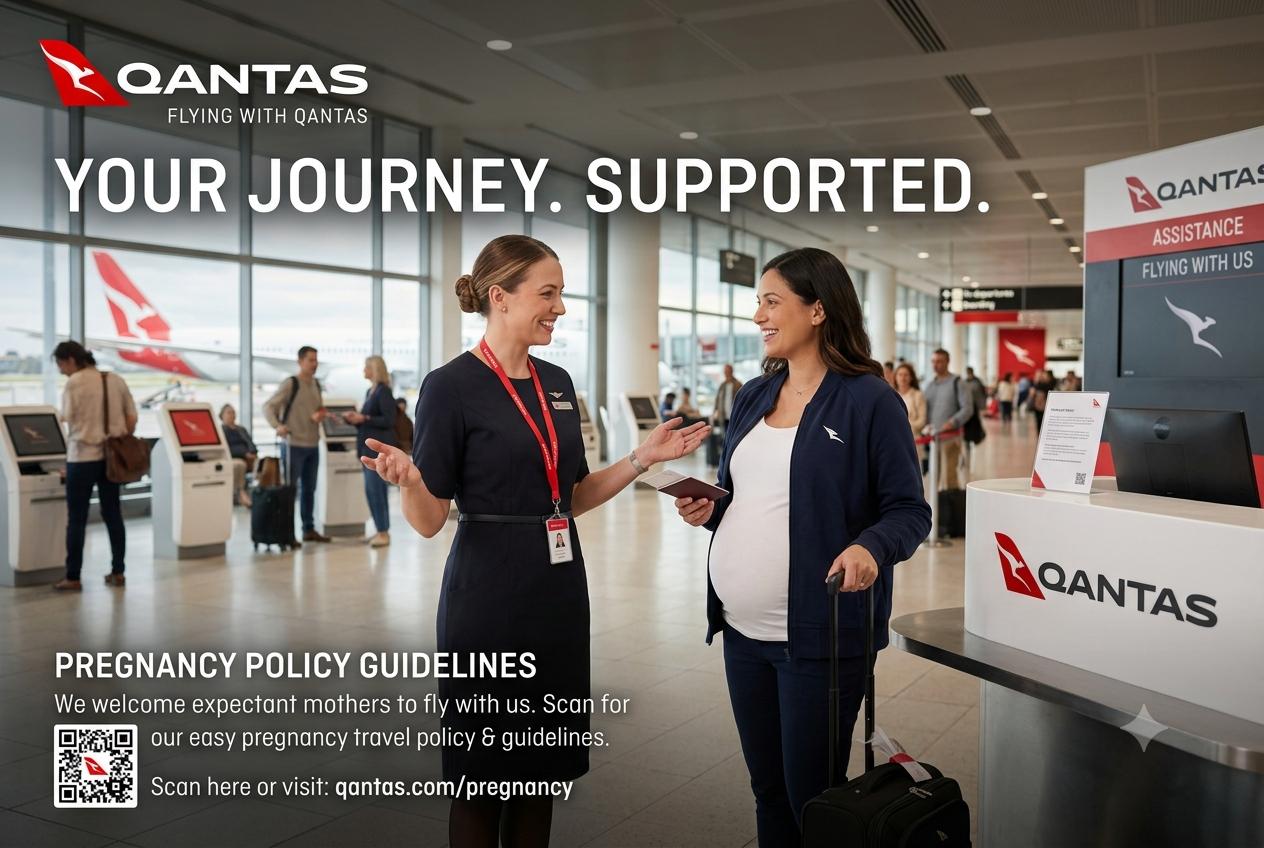
Under the official Qantas pregnancy policy, expectant mothers with routine, complication-free pregnancies can fly up to 28 weeks without medical documentation. Beyond 28 weeks, Qantas requires a medical certificate or letter signed by a doctor or midwife.
Planning a babymoon or an essential journey while expecting requires clear preparation. Whether you are taking a short domestic flight or a long-haul international trip, understanding the rules for Qantas flying while pregnant ensures a smooth and stress-free journey.
Need help updating your itinerary or confirming flight requirements? Call the Qantas pregnancy assistance helpline support team at +1-833-894-5333 for fast travel assistance.
Disclaimer: We are an independent travel assistance agency, not officially affiliated with any airline, but here to help you with your travel queries and support you every step of the way.
Qantas Pregnancy Restrictions by Flight Duration & Trimester
The maximum gestational age at which Qantas allows travel depends on whether you are carrying a single baby or multiples, as well as the scheduled duration of your flight.
Flights Under 4 Hours:
Single Pregnancy: Permitted up to the end of the 40th week.
Multiple Pregnancy (Twins/Triplets): Permitted up to the end of the 36th week.
Flights 4 Hours or Greater:
Single Pregnancy: Permitted up to the end of the 36th week.
Multiple Pregnancy (Twins/Triplets): Permitted up to the end of the 32nd week.
Single Pregnancies
For routine, uncomplicated single pregnancies, you may travel up to the 36th week on flights lasting 4 hours or longer. For shorter regional flights under 4 hours, travel is permitted through the end of the 40th week.
Qantas Pregnancy Travel Policy: Multiple Pregnancies
Expectant mothers carrying twins, triplets, or higher-order multiples face stricter timeline limits. On flights 4 hours or longer, travel is permitted only up to the end of the 32nd week. On flights under 4 hours, you may fly up to the end of the 36th week.
Understanding the Qantas Flying Past 28 Weeks Rules
Once you enter your 28th week of gestation, Qantas mandates that you carry official medical documentation. This letter or certificate confirms that your pregnancy is progressing without complications and that you are fit to board.
Requirements for the Qantas Fit to Fly Certificate (Pregnancy)
Your Qantas fit to fly certificate pregnancy document or written letter must be issued by a registered medical practitioner or certified midwife. The document must clearly state:
Your estimated due date (EDD).
Whether it is a single or multiple pregnancy.
That the pregnancy is uncomplicated and routine.
That you are fit for the specific air travel duration booked.
Always keep this certificate in your carry-on bag, as gate agents or flight attendants may request to inspect it during check-in or boarding.
When Is a Qantas Pregnancy Medical Clearance Form Required?
A basic letter or doctor's certificate is sufficient for routine pregnancies. However, if you experience pregnancy-related medical complications (such as gestational hypertension, placenta previa, severe anemia, or a history of premature labor), a standard note will not suffice.
In these cases, you must obtain a formal Qantas pregnancy medical clearance form completed directly by your attending obstetrician or physician. The completed form must be submitted to the Qantas Travel Clearance or Aviation Medicine department for formal review prior to departure.
If you are unsure whether your medical condition requires formal clearance, reach out via the Qantas pregnancy travel help contact number at +1-833-894-5333 to verify requirements before your travel date.
Essential Tips for Flying While Pregnant on Qantas
To maximize comfort and safety when flying during pregnancy, keep these practical tips in mind:
Select an Aisle Seat:Sitting in an aisle seat makes frequent trips to the lavatory easier and allows you to stretch your legs without disturbing neighboring passengers.
Avoid Emergency Exit Rows:Safety regulations prohibit pregnant travelers in their third trimester from occupying emergency exit rows, as these seats require passengers to operate heavy doors during emergencies.
Wear Compression Socks:Wearing medical-grade compression stockings improves lower-leg circulation and helps prevent deep vein thrombosis (DVT) during long flights.
Fasten Seatbelts Low:Place your seatbelt low across your hip bones, resting under your abdomen rather than across your belly.
Stay Hydrated:Drink plenty of water throughout your flight to counteract low cabin humidity.
Need Travel Assistance? Contact Support
Navigating airline medical forms, changing travel dates, or arranging special airport assistance can be overwhelming when expecting. For dedicated travel support, ticket adjustments, and itinerary management, call our travel desk through Grouptripo using the Qantas customer service phone number at +1-833-894-5333.
Frequently Asked Questions
Can I fly with Qantas after giving birth?
Qantas generally restricts air travel within the first 48 hours following an uncomplicated vaginal delivery. Medical clearance is required if you plan to fly within 7 days of giving birth, and newborn infants must be at least 48 hours old (or up to 7 days old depending on medical clearance) before traveling.
Can you fly at 34 weeks pregnant in Australia?
Yes, you can fly at 34 weeks pregnant in Australia for routine pregnancies. However, major Australian airlines require a medical certificate or doctor’s letter issued after 28 weeks. Stricter limits apply to multiple pregnancies or flights over 4 hours.
Can I fly if I am 7 months pregnant?
Yes, you can generally fly at 7 months pregnant (around 28–31 weeks). Most airlines allow travel during this period but require a signed medical certificate from your doctor or midwife confirming your estimated due date and fitness to fly.
How many weeks pregnant can you fly domestically in Australia?
For uncomplicated single pregnancies on short flights under 4 hours, you can fly up to the end of the 40th week. For longer flights, the limit is typically 36 weeks, with a doctor’s certificate required after 28 weeks.
Why can't you fly after 37 weeks?
Flying after 37 weeks is restricted because full-term labor can start at any moment. In-flight medical resources and space are extremely limited, posing significant safety risks to both mother and baby if delivery or complications occur at high altitudes.
Make sure to review the Qantas pregnancy requirements prior to your trip.
Conclusion
Understanding the Qantas Pregnancy Policy allows you to plan your travel safely and confidently. Keep track of your gestational timeline, obtain a fit-to-fly letter if traveling past 28 weeks, and ensure high-risk pregnancies receive proper medical clearance prior to boarding. For round-the-clock booking help or Qantas Pregnancy travel assistance, call +1-833-894-5333 today.